
The short answer
Confirm the intended SOC 2 scope with the examining CPA, assign control owners, and map each evidence request to a real activity. Preserve dates, system context, and approval records. Readiness work organizes and improves preparation; it does not issue an independent SOC 2 report or guarantee an examination result.
Illustrated guide
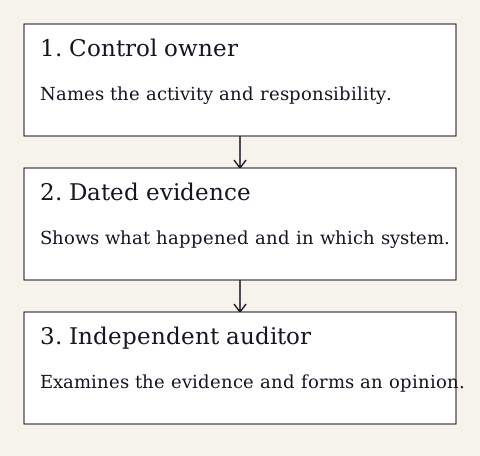
Read the diagram as text
- Control owner: Names the activity and responsibility.
- Dated evidence: Shows what happened and in which system.
- Independent auditor: Examines the evidence and forms an opinion.
Confirm the purpose and system boundary
A request for a SOC 2 report can arrive before a leadership team understands what the requester needs. Ask which service the request concerns, who will use the report, and what question the report is expected to answer. AICPA describes SOC as a suite of services CPAs may provide concerning controls. Coordinate the examination scope and expected evidence with the CPA rather than guessing from a generic checklist.
For a nonprofit or district, the practical question may instead be how to evaluate a software supplier that presents a SOC report. Establish whether your organization is preparing for its own examination or reviewing someone else’s evidence. Those are different assignments. If preparation is appropriate, identify the systems, people, information, and providers that support the service under consideration.
Connect evidence to actual work
Create a working register with the control activity, its owner, its frequency, the source system, and a secure evidence location. Record what the evidence is meant to demonstrate. A policy explains an expectation; an approval record may show that somebody followed it. Keeping these purposes separate helps prevent a folder of polished documents from being mistaken for a record of operating activities.
Begin with a small walkthrough. Ask an owner to demonstrate how an access request moves from business approval to account setup and later review. Identify the records produced along the way. If the workflow leaves no usable record, discuss a sustainable improvement. Do not reconstruct approvals as if they existed earlier. Preserve the distinction between historical evidence and a process introduced during preparation.
Keep context attached to every item
A screenshot of a setting needs enough context to identify the application, relevant configuration, and collection date. An exported account list needs its scope and filters. A completed review needs the reviewer, the population examined, the decision, and follow-up records. Agree with the examining team on suitable evidence forms before repeatedly collecting material that may not answer the intended request.
Protect sensitive information throughout collection. A full participant database is rarely a sensible default attachment to an evidence request. Ask whether a redacted record, a limited sample, or a controlled demonstration will establish the relevant fact. Use approved storage with defined access. Avoid spreading evidence across personal mailboxes, untracked file shares, and multiple copies that become difficult to correct or remove.
Handle gaps as improvement work
Illustrative example: a small service team can demonstrate that employee accounts were disabled, but the associated requests do not identify who approved the departures. The preparation task is to describe the gap accurately, determine what existing records establish, and improve the workflow going forward. It is not to add backdated approvals. The examining CPA determines how the evidence affects the examination.
Assign a person and a target date to each improvement. Note whether the change depends on a supplier, an application setting, or a leadership decision. Recheck a newly introduced process with a real authorized transaction when appropriate. A template alone cannot demonstrate that staff understand a procedure or that the system retains the records the organization intends to collect.
Maintain a useful readiness record
Use a consistent naming convention and a request index so owners can locate the current evidence without searching every folder. Keep open questions visible, including uncertain scope and missing historical records. Agree on how updates replace earlier versions without obscuring what was previously supplied. Review collection effort with staff so preparation does not silently displace essential service work.
The SOC 2 readiness service at SOC 2 Readiness is a route for organizing scope, ownership, and preparation work. Keep the readiness adviser’s role distinct from the independent examination. A useful preparation outcome is a traceable account of the system and its controls, a workable collection process, and an honest list of remaining gaps that leadership and the CPA can evaluate.
Sources and further reading
This field note is general educational guidance. Your organization’s requirements, scope, and service arrangements determine the work that applies.